La Jolla Shores' Real Ceiling Isn't 30 Feet. It's 0.6.
August 27, 2026
August 27, 2026
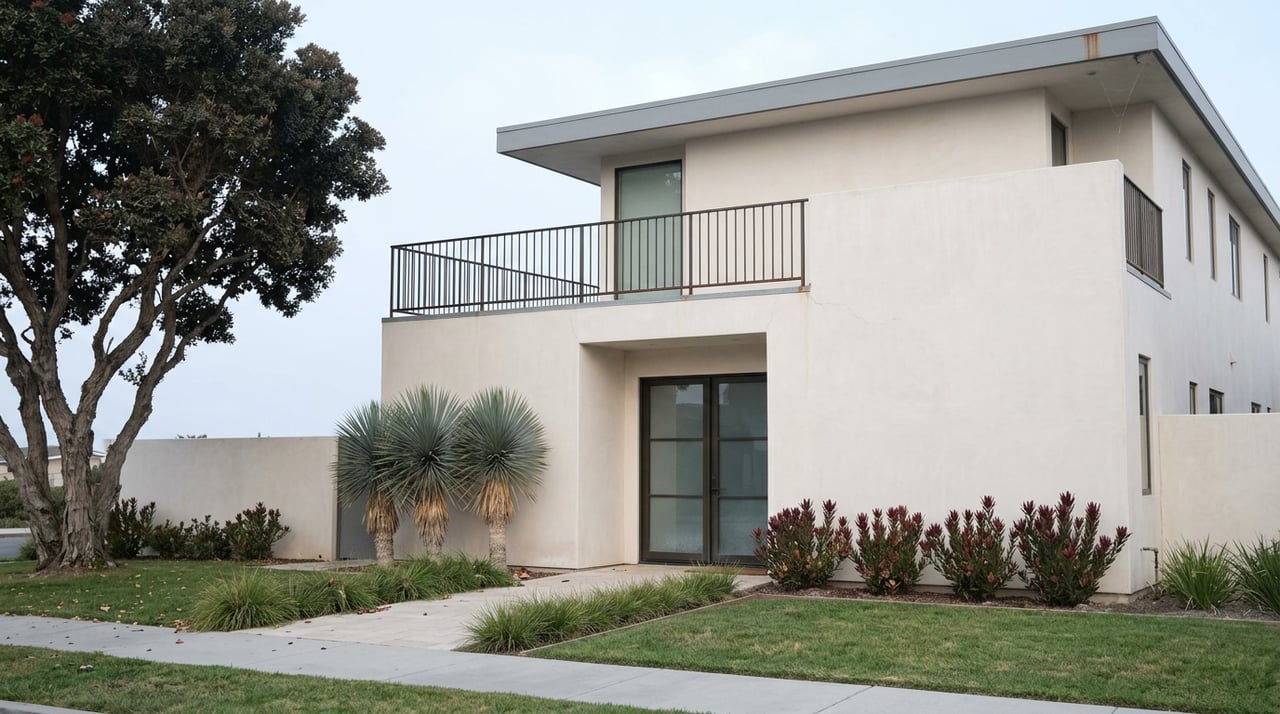
In April 2026, a hearing officer in San Diego signed off on a teardown at 8204 La Jolla Shores Drive. The Long-Hanna Living Trust wanted to replace a one-story, 3,214-square-foot house with a two-story, 3,525-square-foot one, designed by Island Architects. Nothing about that sounds unusual for a coastal remodel. What's worth pausing on is how tightly the new design was drawn to the exact edge of what the site allows: a building height of 28.6 feet against a 30-foot limit, and a floor area ratio of .58 against a maximum of .58.
Not close to the ceiling. At it.
That's not a coincidence, and it's not really about the ocean at all. It's the clearest evidence of a mechanism that shapes every lot in La Jolla Shores, whether the listing mentions it or not.
If you've been watching sale prices in the Shores, you may have seen a number that looks alarming: a median sale price down 56.9 percent year over year as of March 2026. Read on its own, that sounds like a neighborhood in freefall.
It isn't. That figure came from a total of 13 closed sales in March 2026, up from 12 the year before. When your entire sample for the month is a baker's dozen, one $8 million teardown lot selling one year and a handful of smaller cottages selling the next can swing the median by more than half without a single home actually losing value. La Jolla Shores is a small, tightly held micro-market, and its monthly medians move on mix, not momentum.
If the median sale price isn't the number that explains what's happening here, what is? It's the one buried in that April permit decision: 0.6.
For most of La Jolla Shores' history, a large lot meant, roughly, a large house. That changed with a 2021 update to the San Diego Land Development Code, approved through the Coastal Commission process, that placed a maximum 0.6 floor area ratio into the building code for the La Jolla Shores Planned District specifically, a limit that had not applied there before. FAR is simple arithmetic: total building square footage divided by lot size. A 0.6 cap means a 10,000-square-foot lot supports at most 6,000 square feet of building, full stop, regardless of what a buyer is willing to spend to get more.
This is the detail that a listing photo of a wide, flat lot won't show you. The lot's acreage tells you what land you're buying. It does not tell you what you're allowed to build on it. Those are two separate numbers, and since 2021 they've been governed by two separate rules.
The FAR cap doesn't operate alone. It sits on top of a height limit that's been in place since long before most current Shores homeowners bought in: the 30-foot Coastal Height Limit Overlay Zone, created by Proposition D, which San Diego voters approved in 1972 and which took effect that December. The city's own technical bulletin on the rule spells out how strictly it's measured. Height is calculated from a reference datum to the highest point of the roof, and that includes parapets, mansards, mechanical equipment, vents, and antennas. There's no separate allowance for rooftop clutter. Whatever pokes up highest is what counts against the 30 feet.
So a Shores buyer isn't managing one constraint. They're managing two that interact. A wide, shallow lot might hit its FAR ceiling with room to spare on height. A narrow, sloped lot might hit the height ceiling first, especially once a design accounts for how the city measures grade on uneven sites. The 8204 La Jolla Shores Drive project landed close to both limits at once, at 28.6 of 30 feet and .58 of .58 FAR, which is what a fully optimized, professionally designed project on a tightly regulated lot looks like when it's built to use every allowance the code gives it.
Here's where the mechanism connects back to money. Recent per-square-foot figures show La Jolla Shores selling in the neighborhood of $1,480 per square foot as of spring 2026, well above the roughly $1,037 per square foot that greater La Jolla was running at in August 2026. The instinct is to credit the gap entirely to beach proximity. Proximity matters, but it's not the whole story.
When a regulation fixes the ceiling on buildable square footage, the finished square footage that already exists on a lot becomes scarcer in a way it isn't in neighborhoods without that cap. You can't simply pay more to get more house on the same parcel. That turns existing, permitted square footage into the constrained resource, and constrained resources carry a premium that has nothing to do with sentiment or lifestyle marketing. It's supply, capped by code.
This is easier to see by contrast. Outside the Shores Planned District and its commercial core, the rest of La Jolla, including neighborhoods like Bird Rock, is governed by the same zoning regulations applied citywide rather than the Shores' specific FAR cap. That distinction was live this spring in a separate case: a Bird Rock bluffside remodel proposal that would have expanded a home from 1,957 to 4,388 square feet, a 124 percent increase, working through the La Jolla Development Permit Review Committee under citywide standards rather than the Shores' fixed ceiling.
Same peninsula, same ocean air, different rulebook. That's the piece that gets lost when buyers compare La Jolla Shores to its neighbors purely on price. The comparison that actually matters is regulatory, and it doesn't show up in a listing sheet.
If you're evaluating a property in La Jolla Shores with remodeling or rebuilding in mind, the due diligence that matters most happens before escrow, not after.
None of this is a reason to avoid La Jolla Shores. It's a reason to walk in with the right questions. A large, flat, beautifully situated lot can still turn out to have less room to grow than its acreage suggests, and the buyer who understands the FAR math before making an offer is negotiating from a stronger position than the one who finds out at the permit counter.
Does a bigger lot in La Jolla Shores mean I can build a bigger house? Not automatically. Since 2021, buildable square footage in the La Jolla Shores Planned District is capped at a 0.6 floor area ratio, so the lot's size only tells you the outer limit of what the code allows, not what you're guaranteed to be able to build once height, lot coverage, and design review are factored in.
What actually counts toward the 30-foot height limit? The city measures from a reference datum to the highest point of the structure, and that includes the roof, parapets, mansards, mechanical equipment, vents, and antennas. There's no exemption for rooftop equipment, so a design has to account for it from the start rather than treating it as an afterthought.
How do I find out the FAR and permit history on a specific Shores address? Request records directly from San Diego Development Services. Recent public hearing decisions, like the one issued for 8204 La Jolla Shores Drive in April 2026, also show how the city documents FAR, height, and lot coverage compliance for approved projects, which is useful context when comparing what's been allowed on similar lots nearby.
If you're weighing a purchase in La Jolla Shores and want a clear read on what a specific lot can actually support, not just what the square footage suggests, Sherrie O'Hearn can walk you through the comparables, the permit history, and the questions worth asking before you write an offer. Let's Connect.
Stay up to date on the latest real estate trends.
Experience a personalized real estate journey backed by decades of industry knowledge, local expertise, and trusted Berkshire Hathaway HomeServices guidance. Whether buying or selling, Sherrie O. is committed to delivering exceptional service from start to finish.