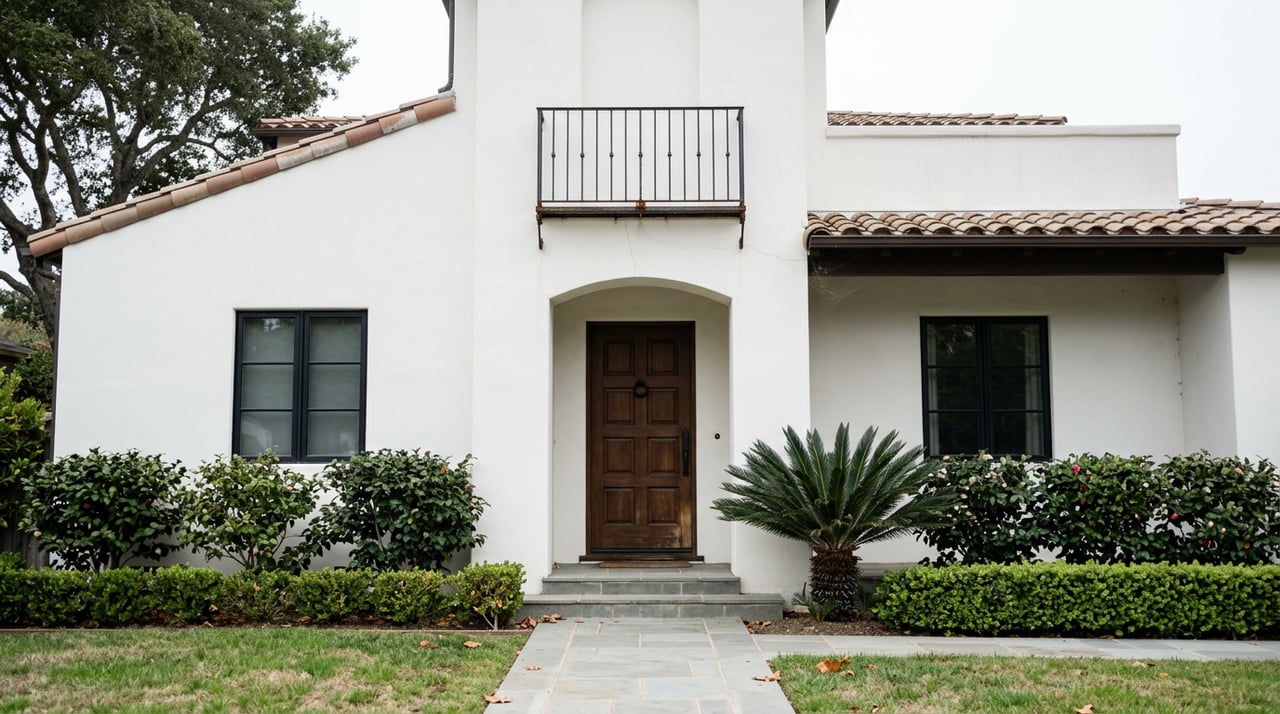
Point Loma's Real Divide Isn't the View. It's the Flight Path.
August 20, 2026
August 20, 2026
Why would two homes ten minutes apart, both carrying a Point Loma address, list a million dollars or more apart in price? A buyer touring both might get an answer that sounds almost incidental: the cheaper house had its windows and doors replaced years ago "through the airport program." Most people nod politely and move on to the kitchen. That line deserves a second look before it does.
Point Loma gets talked about, priced, and reported on as if it were one real estate market. It isn't. It is closer to five markets sharing a single name, and the split between them owes less to square footage or which direction a window faces than to something as unglamorous as which side of a takeoff corridor a lot happens to sit on.
The peninsula's sub-neighborhoods carry very different price ceilings. Zillow's typical home value estimates, as of August 2026, show Sunset Cliffs at $2,471,692, the Wooded Area at $2,051,491, Roseville-Fleet Ridge at $1,808,828, and Loma Portal at $1,620,229. Current active listings push the spread further still: La Playa's live listing median sits at $3,022,500, more than double Loma Portal's current listing median of $761,000, according to the same snapshot.
That gap alone would be worth explaining. What makes it more interesting is that the peninsula-wide numbers people quote as "the Point Loma median" don't even agree with each other. In the three months through June 2026, one measure put the overall Point Loma median sale price at $1.47M, down 11.9% year over year. A different geographic cut, labeled Point Loma Peninsula, showed a $1.6M median in February 2026, up 8.7% over the same period. Meanwhile, year-to-date figures from the San Diego Association of REALTORS pegged the single-family median at $1,782,500 through February 2026, with condos and townhomes at $1,103,250. Three sources, three numbers, all technically describing the same peninsula.
That disagreement isn't a data error. It's a symptom. When a geographic label bundles five markets with a four-figure spread, the reported median depends entirely on which properties happened to close during the sampling window, not on any real center of gravity in the market itself.
San Diego International Airport runs on a single runway, and it operates in its westbound configuration, runway 27, roughly 80% of the time because of prevailing winds. In that configuration, departing jets climb west directly over the Point Loma peninsula before banking south or east. That corridor is narrow, and it sits low over the peninsula's flatter, low-lying neck rather than its elevated flanks. One local real estate guide describes Loma Portal, along with parts of Ocean Beach, as directly under the flight path for most takeoffs, with jets passing overhead at roughly 1,000 feet, based on 2024 estimates comparing altitudes across the corridor. Liberty Station sees departures closer to 800 feet, while neighborhoods further inland along the same corridor, like South Park and Bankers Hill, see planes at roughly 1,100 feet and under 400 feet.
This isn't a recent complaint. A longtime Point Loma homeowner told the San Diego Reader in 2008 that back in 1976, he'd noticed housing prices under the flight path running about 20% below homes outside it, and that the gap was part of why he and his wife could afford a larger, more attractive house. Fifty years later, the same geography still separates La Playa's bayfront and the Wooded Area's ridge, both largely clear of the primary departure swath, from Loma Portal's flatter, closer-in streets.
If a Loma Portal listing has already been through the airport's noise mitigation program, that history is worth understanding before it becomes a footnote in escrow.
The Quieter Home Program is an FAA-approved residential sound insulation program run by the San Diego County Regional Airport Authority. It targets homes inside the FAA's 65-decibel noise contour and aims to cut interior noise by at least 5 decibels through upgraded windows, doors, and ventilation systems. As of a July 2025 funding announcement, the program had retrofitted 5,929 homes, and a new $15 million FAA grant was set to fund roughly 250 more, with eligible communities specifically named as Loma Portal, Ocean Beach, Bankers Hill, Middletown, Golden Hill, and South Park, according to 10News. The process typically takes a year and a half to two years once a homeowner is placed in a funding group.
Two details matter for a buyer evaluating a home that's already gone through this program. First, the county assessor's office will not increase a home's assessed value because it participated in the program, according to the airport authority's own program guidance, though owners are asked to complete a form for the assessor's records during construction. Second, local reporting and longtime residents describe an avigation agreement as part of the process, a document in which the homeowner gives up certain rights to the airspace above the property in exchange for the federally funded retrofit. If a home you're considering has had this work done, it's worth asking your agent to confirm exactly what was signed and what it means for the parcel going forward, rather than assuming new windows are simply a cosmetic upgrade.
One piece of the noise picture actually works in a buyer's favor: SAN operates under a voluntary noise abatement curfew from 11:30 PM to 6:30 AM, restricting most operations overnight. Whatever a specific address experiences during the day, the corridor is quiet on a predictable schedule every night.
It would be easy to assume that anything with ocean frontage automatically outprices anything without it, and that the flight path is the only variable that matters. Point Loma's own numbers complicate that too. Bayside La Playa, which sits outside the primary departure corridor, tends to price above oceanfront Sunset Cliffs, largely because La Playa's homes sit on larger lots with more square footage, and because some properties come with private beach access at Kellogg Beach or proximity to the marinas and yacht clubs along the cove. View matters, but lot scale, water access, and flight exposure are three separate levers, and they don't always move together the way a simple "oceanfront costs more" assumption would predict.
The practical takeaway for anyone shopping this peninsula is to stop anchoring to a single Point Loma median and start treating each sub-neighborhood as its own comp set. A few concrete steps help:
Is every home in Loma Portal under the flight path? Not uniformly. Exposure depends on the specific block and elevation, and the neighborhood does rise toward the northwest, where some properties sit above the loudest part of the corridor. Checking a specific address against SAN's flight tracking tool gives a clearer picture than relying on the neighborhood name alone.
If a home has already been through the Quieter Home Program, will my property taxes go up? The county assessor's office has stated it will not increase a home's assessed value based on participation in the program itself. Confirm the home's program history and any related paperwork with your agent before closing.
Why does La Playa cost more than oceanfront Sunset Cliffs? Lot size and home scale play a larger role than proximity to the water. La Playa's bayside lots tend to be larger, its homes tend to be grander, and some properties include private beach access or walking distance to the yacht clubs along the cove, all of which add up to a premium that isn't only about which direction the windows face.
If you're comparing homes across Point Loma's sub-neighborhoods and want a read on what a specific address is really worth, Sherrie O'Hearn can walk through the comps, the corridor, and the paperwork with you before you write an offer. Let's Connect.
Stay up to date on the latest real estate trends.
Experience a personalized real estate journey backed by decades of industry knowledge, local expertise, and trusted Berkshire Hathaway HomeServices guidance. Whether buying or selling, Sherrie O. is committed to delivering exceptional service from start to finish.